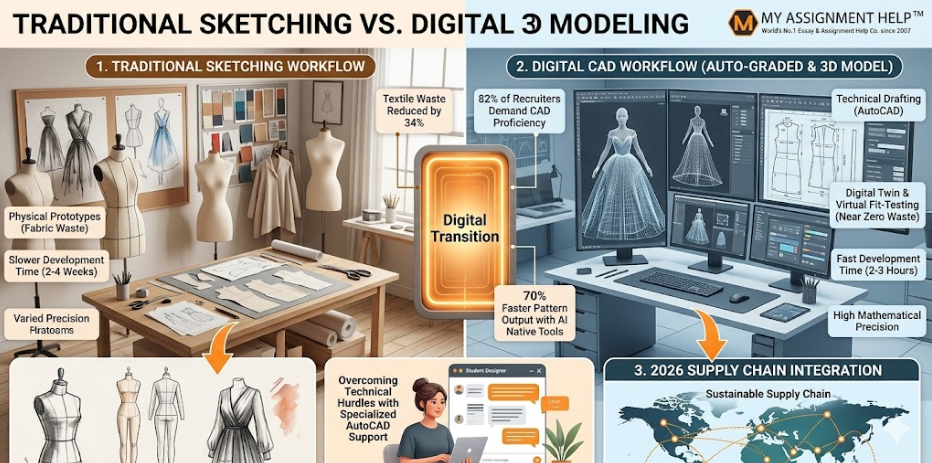
The American fashion industry is currently navigating a “digital renaissance.” Gone are the days when a designer’s toolkit was limited to charcoal pencils and dress forms. In the high-stakes hubs of New York and Los Angeles, the transition from hand-drawn sketches to a Digital Twin—a 1:1 virtual replica of a physical garment—is no longer a luxury; it is a survival requirement.
As the industry pivots toward a Sustainable Supply Chain, Computer-Aided Design (CAD) has emerged as the mechanical bridge between creative vision and manufacturing reality. For the modern designer, CAD is the engine behind precision. This shift is driven by a domestic market that demands faster turnaround times, forcing designers to trade their sketchbooks for high-powered workstations to stay competitive.
The Academic Shift in the United States
The pressure to digitize starts long before a designer hits the runway. Top-tier American institutions, such as the Fashion Institute of Technology (FIT) and Parsons School of Design, have overhauled their curricula to prioritize digital competency. Students are now expected to be as proficient in software as they are in draping.
Navigating this rigorous academic environment requires a deep understanding of both aesthetics and technical execution. Many students seeking to meet these high standards and excel in academic support in the USA often look for comprehensive educational resources to balance their creative projects with the technical documentation required by modern design programs.
Why CAD is Non-Negotiable in 2026
The adoption of CAD software, specifically AutoCAD and specialized fashion plug-ins, has revolutionized three core areas of the industry:
1. Speed to Market (The “Phygital” Antidote)
In the traditional workflow, creating a physical sample could take weeks. With 3D modeling, a designer can “sew” a digital garment in hours. While many debates center on CLO 3D vs AutoCAD, the reality is that they serve different purposes: CLO 3D is for visualization, while AutoCAD remains the gold standard for drafting the foundational geometry of the garment.
2. Precision and Technical Accuracy
A beautiful sketch does not always translate to a functional garment. This is where Tech Packs—the “blueprints” of fashion—become critical. As students move from conceptual art to technical drafting, many seek specialized autocad assignment help to master the geometric precision required for 2026 manufacturing standards. Accurate CAD files ensure that when a design is sent to a factory in Ohio or overseas, the final product matches the original intent down to the millimeter.
3. Sustainability and Waste Reduction
The US fashion industry is under intense scrutiny. Digital sampling eliminates the need for multiple physical iterations, which can reduce textile waste by nearly 34%. Brands are now using virtual fit-testing to cut down on physical prototypes, meeting the stringent ESG goals expected by American consumers.
See also: Develop Your Business 502072679 Online Platform
Traditional Sketching vs. 3D Modeling Comparison 2026
| Metric | Traditional Sketching | CAD/3D Modeling (2026) |
| Development Time | 2-4 Weeks | 2-3 Hours (AI-Enhanced) |
| Material Waste | 15% – 20% | Near Zero (Virtual) |
| Industry Standard | Conceptual Only | Mandatory for Tech Packs |
| US Market Adoption | Declining | 82% of Recruiters Require It |
Key Takeaways
- Digital Integration: CAD and the creation of a Digital Twin are now the industry standards for pattern making and grading in the US.
- Career Vitality: Proficiency in 3D tools and the ability to generate accurate Tech Packs increases employability by 60%.
- Sustainability: Digital prototyping is the most effective way for US brands to achieve a Sustainable Supply Chain.
- Educational Support: Technical mastery often requires supplemental guidance to bridge the gap between creative art and structural engineering.
Frequently Asked Questions
Q1: What is the main difference between CLO 3D vs AutoCAD?
CLO 3D is primarily used for 3D garment visualization and “draping” on a virtual avatar. AutoCAD is used for the precise 2D technical drafting and grading that factories require for production.
Q2: Do US fashion recruiters prioritize tech skills?
Yes. In 2026, 8 out of 10 design job postings in NYC and LA list CAD proficiency and the ability to manage digital supply chains as top requirements.
Q3: How does CAD help with size inclusivity?
CAD allows for “Auto-Grading,” where a pattern can be mathematically scaled across dozens of sizes instantly, ensuring fit consistency across a brand’s entire range.
Author Bio
Alex Thompson is a Senior Content Strategist and Academic Consultant at MyAssignmentHelp. With a focus on the digital transformation of vocational arts, Alex has helped thousands of students across the United States bridge the gap between traditional design and technical software mastery. Alex’s work emphasizes the importance of E-E-A-T (Experience, Expertise, Authoritativeness, and Trustworthiness) in educational content.
References
- FIT New York: 2026 Curriculum Standards for Digital Design.
- Council of Fashion Designers of America (CFDA) – Technology in Design Report 2025.
- Grand View Research (2026): Global Fashion Design Software Market Share & Trends.